Mar
16/2026
After long use, every blade will become dull. Blade wear depends on the quality of steel, usage and maintenance of the blade. This guide describes the correct usage and maintenance of any kitchen knife (not just Japanese) in order to extend its lifespan and enjoy a sharp blade all the time.
Regular Sharpening
A sharp knife is a safe knife. The sharper the knife, less chance to get cut. It will follow our hand movement and won't slip easily. A sharp knife will damage the cells of our food less, meaning the ingredients will stay fresh longer and preserve more taste when cooking.
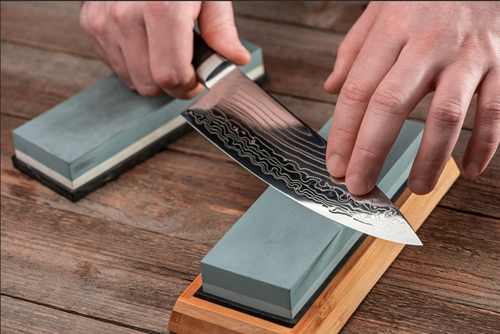
Knife sharpening is not a difficult task. We are big supporters of the idea that everyone should learn how to sharpen a knife. We advise to invest a little bit of your time and learn sharpening technique. It only takes some practice and you can't really damage the knife. Once you get some grip it shouldn't take more than 10-15 minutes to sharpen a knife.
Short and simple: whenever you feel your knives are not cutting as good as you would want them to. Japanese chefs sharpen their knives every day at the end of their shift. You don't need to go to such lengths. Our guidelines are:Home cook ,1x/month;Professional chef ,1x/week,These are rough estimates. There are several factors that influence the frequency of knife sharpening:
Quality/hardness of steel. The better the steel, the longer a blade will hold a sharp edge. ZDP-189 steel knives are the best knives in our offer with a hardness of 67 HRC. These will remain sharp approximately 30% longer than "regular" Japanese knives with a hardness of 61-64 HRC (like those beautiful knives made by Shigeki Tanaka, or our entry level Kuro-uchi series). German or French knives with the average hardness of 54-58 HRC will hold a sharp edge for the proportionally shorter time.
Usage of a knife. Fairly simple - the more you use your knife, more often it needs to be sharpened. Learning proper cutting techniques will also help. If knife manufacturer doesn't disclose steel type and its hardness, then it is very likely that steel is not the highest grade.
Proper maintenance. Much like any tool, regular maintenance, proper storage and correct usage will prolong the sharpness of your knives. Read the rest of this guide to learn the best ways to properly maintain your knives.
Other factors that influence the frequency of sharpening are:
·surface/material of our cutting board,
·type of ingredients we cut most often,
·our cutting skills
Which tools do I need to sharpen my knives?
Great question. We made it easy for you and created multiple sharpening sets based on the skills of the sharpener.
Regular blade straightening - Honing rod!
Contrary to common belief, a honing rod or butcher’s steel is not used to sharpen the blade, but to straighten it. It straightens the tip of the blade for microscopic realignment and removal of blade deformations.
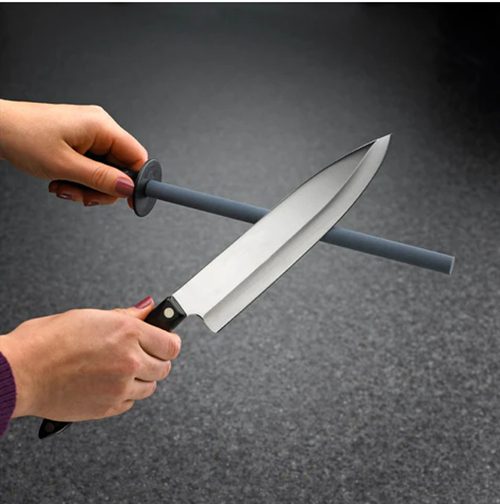
Imagine a nice, flat piece of paper. If you pass your finger over the edge of it you can cut yourself. If you crease the paper, the edge (although as thin and sharp as before) is not straight anymore and you cannot get cut. Likewise, a honing rod straightens the edge of the kitchen knife blade and therefore makes the blade straight and sharp again. Blade straightening takes roughly 10 seconds. The more frequently knives are straightened, the better it is.
Once the honing rod fails to improve blade sharpness, it is time to sharpen the knife with sharpening stones. A blade will remain sharp up to 10x longer if the honing rod is used regularly.
⚠️ There is only one thing you need to be careful when purchasing a honing rod - buying the right one for your knife. Coarse cut honing rods, or those added to cheap kitchen sets, are useless. We recommend a fine cut honing rod (made of steel) for German or French kitchen knives made of softer steel (up to 58 HRC) and diamond coated or ceramic rod for knives made of harder steel.
⚠️ Also make sure to start honing at the very heel of the blade and finish at the tip. Any other way will change the profile of the cutting edge - in time a gap will form between the blade and the cutting board, resulting in partially cut food.
We look forward to working with you.
View More
Related Products

 S02340 Multi-Function Tactical Entrenching Tool, 16-in-1 Survival Shovel with Serrated Edge, Knife,
View More
S02340 Multi-Function Tactical Entrenching Tool, 16-in-1 Survival Shovel with Serrated Edge, Knife,
View More 
 KA81 Hollow Aluminum Alloy Fish Gripper with Safety Lanyard, Stainless Steel Fish Lip Grip Plier, Po
View More
KA81 Hollow Aluminum Alloy Fish Gripper with Safety Lanyard, Stainless Steel Fish Lip Grip Plier, Po
View More
 S02313 Professional Multi-Tool Hammer, Outdoor Camping Survival Multitool with Axe Knife Pliers
View More
S02313 Professional Multi-Tool Hammer, Outdoor Camping Survival Multitool with Axe Knife Pliers
View More
 HS3039 6 pcs Hot selling Forged ABS Double-steel head handle kitchen knife set with wood knife stand
View More
HS3039 6 pcs Hot selling Forged ABS Double-steel head handle kitchen knife set with wood knife stand
View More


 FR
FR  ES
ES  AR
AR  RU
RU  DE
DE